Your child's classroom can feel like two different stories at once. One student finishes quickly and needs more challenge, another is stuck on the basics, and you're left wondering whether the same worksheet is supposed to work for both.
That's where differentiated instruction earns its keep. At its best, it gives your child a task that matches what they already know, what they're ready for next, and how they learn most efficiently, instead of forcing everyone through the same route at the same pace. In a test-prep setting, that matters even more because a strong plan doesn't just add more practice, it changes the type of support your child gets on the exact skill that's causing trouble.
If you want one move to make this week, ask the teacher, “Which grouping, task, or product option is my child using right now, and why?” That one question tells you whether your child is being supported by a real differentiation plan or just receiving extra busywork.
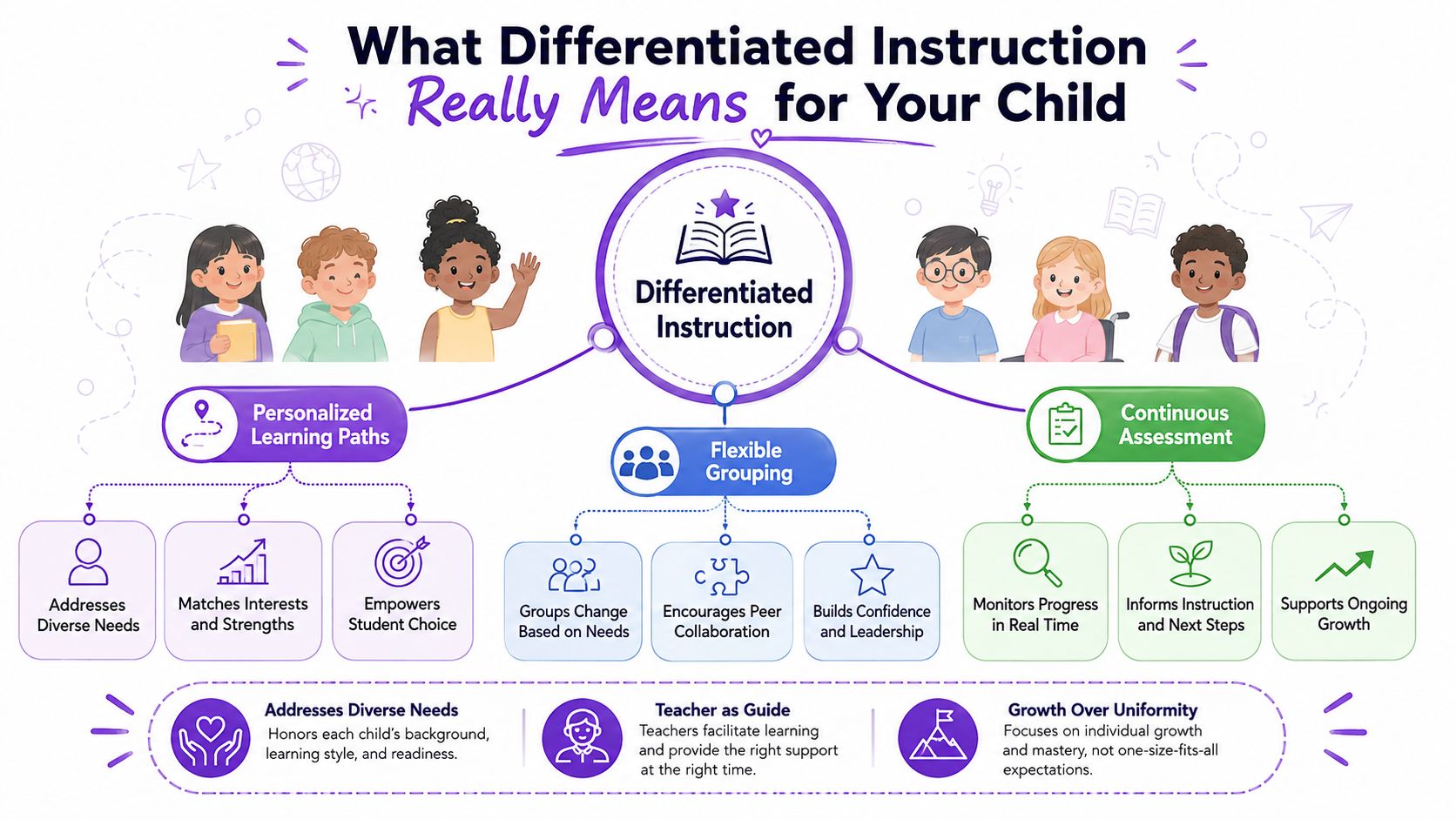
What Differentiated Instruction Really Means for Your Child
The plain-English version
Differentiated instruction means the teacher proactively adjusts what students learn, how they learn it, and how they show what they know, based on readiness, interest, and learner profile. It is a framework, not a one-time accommodation and not a pile of extra worksheets. The point is to keep the learning goal steady while changing the route so the work fits the child in front of the teacher.
That's why static labels can mislead. The stronger model starts with pre-assessment and keeps using ongoing assessment so the teacher can see who needs reteaching, who needs enrichment, and who is ready to move on, as described in the U.S. Department of Education's practice guidance on screening and progress monitoring WWC practice guide.
Practical rule: If your child is always getting the same assignment with a different amount of time, that's not real differentiation. The task should change, not just the clock.
For parents, that distinction matters. A child who is advanced in reading but shaky in writing shouldn't get a blanket “harder work” assignment, because that can miss the actual gap. A strong differentiated lesson changes the task so your child can work right at the edge of growth without drowning in frustration.
What you can ask today
At pickup, by email, or during a conference, ask for one concrete example from this week. You want to know whether your child is in a small group, which version of the task they're doing, and how the teacher is checking mastery before moving them on.
That answer tells you a lot. It shows whether the teacher is using evidence to adjust instruction, which is the heart of the model. It also gives you a home-school bridge, because the same logic applies when you help your child study for a standardized test.
The Four Levers Every Teacher Adjusts
Content, process, product, environment
A useful way to think about differentiated instruction is as four controlled levers, content, process, product, and learning environment, while the learning objective stays the same. That structure is laid out in the practice literature on differentiated instruction as a way to preserve common standards while varying the route to mastery WASA overview.
In a 4th grade fractions lesson, content might look like this, one group gets a visual fraction kit, another group works from standard textbook representations, and both are aiming at the same fraction comparison skill. The teacher isn't lowering the goal, only changing the entry point.
Process is how students work with the idea. One group may compare fraction cards with a partner, while another works through guided practice with the teacher, because some students need more verbal rehearsal before they can do the work independently.
Product is how students prove learning. One child might build a recipe to show fractional understanding, while another writes a short explanation or completes a math talk. The learning target stays fixed, but the output changes to fit the child's strengths.
The room matters too
Learning environment is the part parents sometimes overlook. A quiet corner for focused work, a shared table for problem-solving, and a spot for independent practice can all live in the same classroom if the teacher plans the flow well.
A differentiated classroom doesn't mean chaos. It means the teacher knows which students need which entry point, and the room is set up so those choices are easy to run.
Flexible grouping becomes the connective tissue. Students move between small groups as evidence changes, so they're not trapped in one track. That's the big difference between a thoughtful system and a rigid label.
Grouping by Readiness, Interest, and Learner Profile
How teachers decide who goes where
Three inputs drive most differentiation decisions, readiness, interest, and learner profile. Readiness is where your child is right now on a specific skill. Interest is what pulls your child into the topic. Learner profile is the way your child tends to take in and show learning, such as visual, verbal, hands-on, collaborative, or independent.
Teachers gather that evidence in different ways. They use pre-assessments, short conferences, observation notes, and interest inventories, then they sort students into groups that match the immediate goal. The ERIC-based guidance on differentiated instruction emphasizes that meaningful pre-assessment is what makes differentiation functional, because it gives teachers the information needed to build approaches, choices, and scaffolds SUNY Pressbooks chapter.
Here's how that can look in an EQAO-aligned 2nd grade reading block. One group works with the teacher on decoding multisyllable words, another partner-reads a more challenging passage on a topic they chose, and a third records a retelling with headphones. The learning goal is still reading comprehension, but the path is different for each child.
What to ask in a conference
Ask for a five-minute walkthrough of your child's current grouping. You're not asking for a full lesson plan, just the reason your child is in that group and what evidence the teacher used to place them there.
Ask this directly: “Is my child grouped by readiness, interest, or learner profile right now, and what would make that group change?”
That question matters because grouping should be temporary and responsive. If the teacher can't explain how the group might shift, the plan may be more static than differentiated.
For parents who want a wider testing context, one helpful reference point is understanding how screening and score patterns are interpreted in a cognitive test setting, even though the test itself is different. A parent-friendly overview of score meaning can be useful background reading what a good CogAT score means.
Differentiated Mini-Lessons Across Grade Bands
K to 2, 3 to 5, and 6 to 8 using the same structure
The best mini-lessons don't feel improvised. They follow the same rhythm, a clear learning target, a short modeling moment, a guided practice tier, and a choice product, while the teacher changes the support for each band.
In K to 2, think about a phonemic blending warm-up. Some students clap each sound, some chant the word, and some use picture cards as support. The teacher models once, then moves students into small groups based on who needs more oral practice and who is ready to work more independently.
In 3 to 5, a STAAR-style reading passage can be differentiated without changing the standard. One group annotates a shorter chunk of text with teacher prompts, another group marks evidence and explains why it matters, and a stronger group compares two pieces of evidence across the passage. The final product can still be the same standard, even if the path looks different.
Middle grades can still stay calm
In 6 to 8, a NJSLA-aligned argument writing task works well with choice. One student writes a paragraph, another gives a short speech, and a third creates a one-page infographic. The teacher still looks for claim, evidence, and reasoning, but the product lets students show strength in different formats.
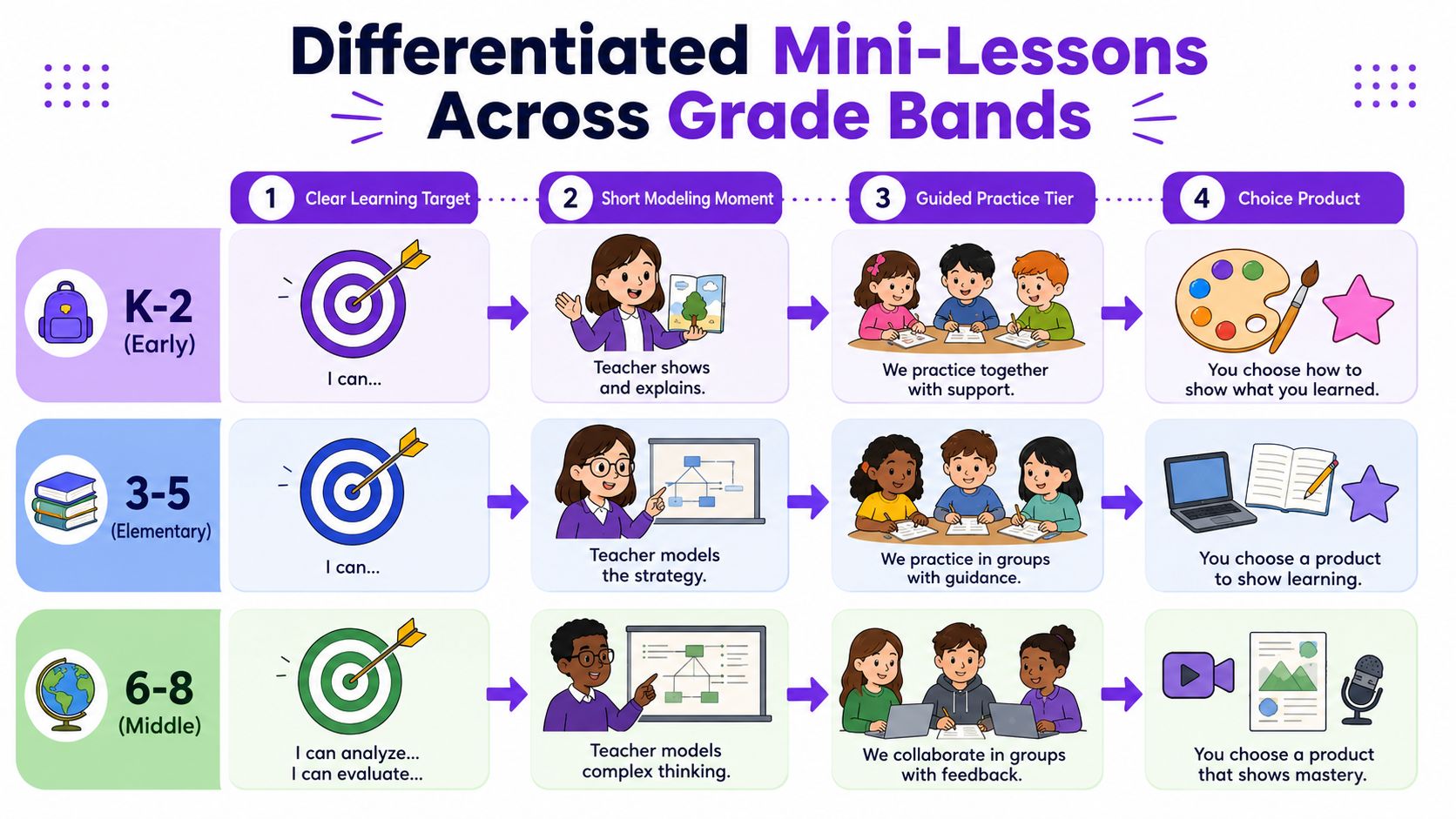
The teacher's prep work is front-loaded. Once the tiers are designed, the lesson runtime feels steady because the directions are already clear and the groups already know what to do. That's why good differentiation often looks calmer than a one-size-fits-all lesson, not more chaotic.
The goal isn't to make every child do different work all day. It's to make sure each child meets the same target through a route that actually makes sense.
Using Diagnostics to Drive Differentiation in Test Prep
The same logic works at home
A child opens a practice book, gets halfway through, and then starts missing the same kinds of questions again. That is usually a sign that the work is not matched to current readiness yet. The same principle that guides classroom differentiation also guides stronger test prep. Start with current readiness, then adjust content, process, and product to match the child's exact need on the test in front of them, whether that's EQAO in Ontario, CCAT in Canada, Texas STAAR, Tennessee TCAP, New Jersey NJSLA, or the Iowa Assessment.
The practical move is clear. Take a diagnostic, identify one or two weak subsections, and build one focused week of practice around those gaps. That week should change the type of work, not just the amount. If your child missed inference questions, for example, they may need a short modeled passage, a guided think-aloud, and then a choice response, not ten more pages of the same item type. The point is precision, each practice session should target the specific skill that needs attention rather than pile on more of everything.
That is why diagnostic tools help parents so much. A strong home routine starts when you can see subsection-level weaknesses clearly, because then you can group practice by need the same way a teacher does in class. If you want a plain-language explanation of how one assessment tool surfaces those patterns, start with this i-Ready diagnostic test overview before building a study plan.
Diagnostic-driven differentiation by test
| Test | Diagnostic Focus | Differentiation Lever to Adjust |
|---|---|---|
| EQAO | Reading, writing, or math skill gaps by item type | Change task complexity and response format |
| CCAT | Reasoning patterns and subsection performance | Shift pacing, item grouping, and practice format |
| STAAR | Texas content-area weaknesses by strand | Re-teach with smaller bands and targeted passages |
| TCAP | Tennessee skill clusters and readiness gaps | Use guided practice, then recheck mastery |
| NJSLA | Evidence use, writing, and reading demands | Vary the product and support level |
| Iowa Assessment | Subsection-level skill gaps | Adjust process and re-sort practice by readiness |
For test prep, the goal is precision, making each practice session more exact rather than overwhelming your child with more. A diagnostic gives you that focus. It shows what to stop repeating and what to start strengthening, so practice time points directly at the skill gap in front of you.
Practical Routines That Prevent Differentiation Overload
Keep the workload manageable
The fear behind most differentiation searches is simple, “Won't this double my prep time?” It doesn't have to if you use a few repeatable routines. The first is an anchor activity, a self-starting task your child can return to when tiered work is done.
The second is a single planning template for tiered tasks. Keep the objective the same, then change the support or complexity level so you aren't rebuilding the whole lesson from scratch each time. The third is a weekly evidence log, which lets you regroup based on what happened instead of trying to remember everything from memory.
Here's a realistic TCAP math rhythm for 5th grade. Monday is a short pre-assessment, Tuesday through Thursday are tiered problem sets, and Friday is a regrouping check. That pattern gives you enough structure to respond to the child's actual work without inventing a new plan every day.
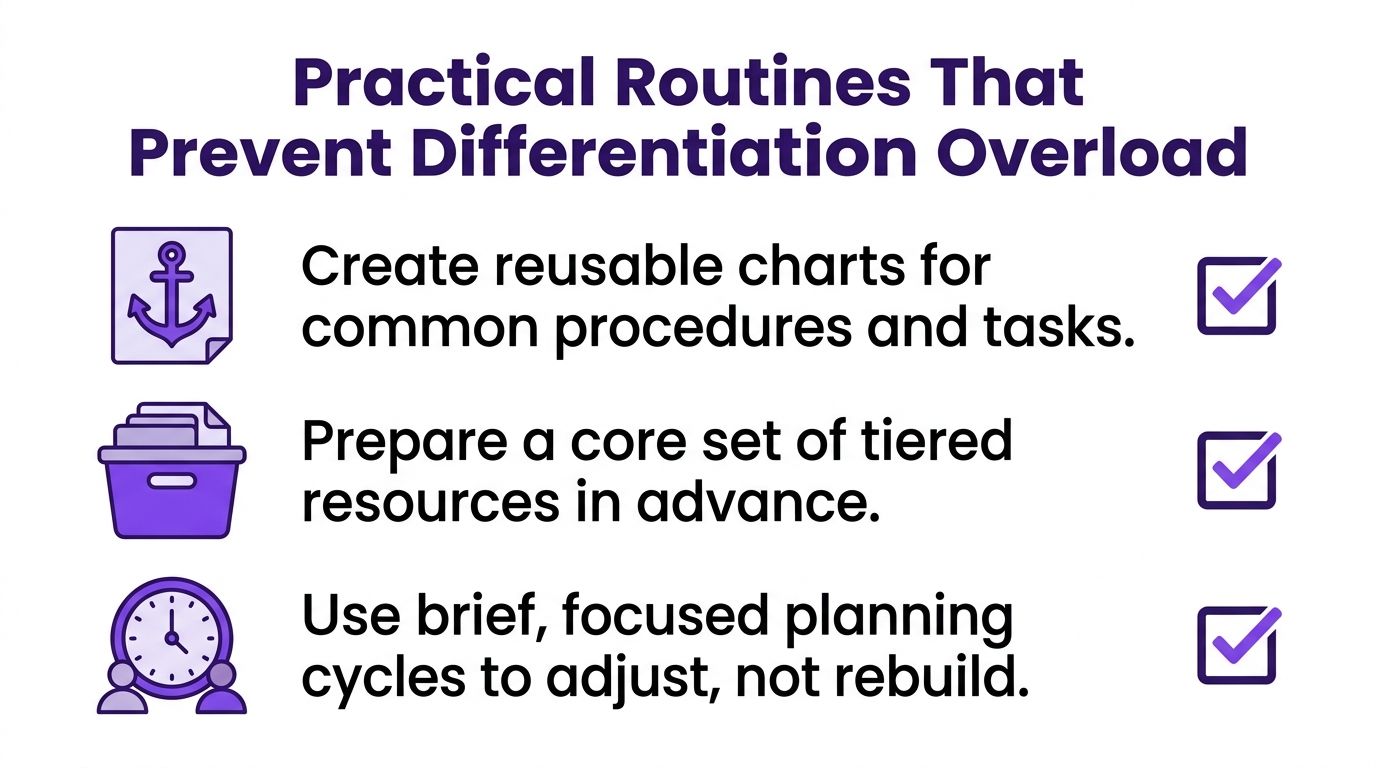
If you're homeschooling or helping at home, the same structure still works. Use one anchor task, one tiered practice set, and one short check-in, then adjust the next session based on what you saw. For a practical companion to that routine, a simple bank of short skill-based activities can help, especially when you need variety without starting over language arts games.
Your Differentiated Instruction Game Plan
Start with a diagnostic, change the type of support instead of just the volume, and regroup as evidence changes. Tonight, pick one test section, run a short diagnostic, design one mini-lesson using the content-process-product template, and note what changed after two sessions. That's the cleanest way to make differentiated instruction feel manageable and useful.
It also lowers test anxiety, because your child isn't facing work that's far too easy or far too hard. They're practicing at the right level of challenge, which usually makes effort feel more focused and less panicked.
Visit TestPrepGenius.com to use the free diagnostic scoring tool, pinpoint subsection weaknesses, and pair the workbook for your child's specific test and grade level with the free companion scoring guide. This content is not affiliated with, endorsed by, or sponsored by the Texas Education Agency, Tennessee Department of Education, New Jersey Department of Education, EQAO, Riverside Insights, or Pearson.
TestPrepGenius.com gives you workbook-based practice for EQAO, CCAT, STAAR, TCAP, NJSLA, and Iowa Assessment, plus QR-code access to free scoring guides, answer explanations, and prep strategies. If you want a clearer plan for your child's weak spots, start with a diagnostic, then use the workbook and companion resources to build a smarter study routine at home.